
Just a day ago, I stumbled upon a podcast where a celebrated children’s book writer confidently declared, “Mugging up without understanding is a complete waste of time.” Naturally, I nodded. Because podcasts have that effect. And then, like all inconvenient thoughts, a question popped up: Is it really?
If mugging up is so useless, why did our childhood come with a compulsory subscription to god stotras, Geeta adhyayas, multiplication tables, poems, and endless *“repeat after me”* sessions? Were elders collectively running an ancient experiment in time-wasting?
As children, we didn’t understand Sanskrit verses, didn’t know what “Yada yada hi dharmasya” meant, and honestly had no interest in why 17 × 6 was 102 except that saying it wrong invited instant correction (sometimes loudly). Yet we memorised them. Word by word. Line by line. Table by table.
At that age, understanding was optional. Repetition was non-negotiable. And here’s the irony: years later, when life gets noisy, those very chants surface uninvited. Tables rescue us during quick calculations. Poems help us find words when we struggle to express. The Geeta verses suddenly start making sense after we’ve lived enough to understand them. Turns out, memorisation was not about immediate comprehension. It was about planting seeds. Children don’t always understand why they are made to do certain things. Elders, on the other hand, know something children don’t yet: the brain remembers long before the mind understands. What feels like “mugging up” in childhood quietly becomes mental infrastructure in adulthood.Understanding matures with age. Memory, however, needs early training.So no, mugging up wasn’t a waste of time. It was deferred understanding. It was preparation. It was elders trusting that one day, meaning would catch up with memory.
I remember the days when my grandmother used to make us learn geeta adhyayaa, hundreds of poems and even good passages mentioned in just any book. We did it then. Later, those paragraphs and poems helped us present good diction. They provided an understanding of our language, which can only be passed from elder generations to the new ones. Even today, my grandmother-in-law told me about the times when our elders knew all 18 adhyayas of Geeta. She suggested that we should also try to remember one adhyaya every year. Yes, people will say, no need to be bothered or why to pay attention to such things…they keep saying such things…they always have lots of expectations…true. but I thought this was a very small suggestion… That to it was supposed to be for my own good. If should be able to spare at least a bit of time for. Myself to learn something new or just do something without any expectations.
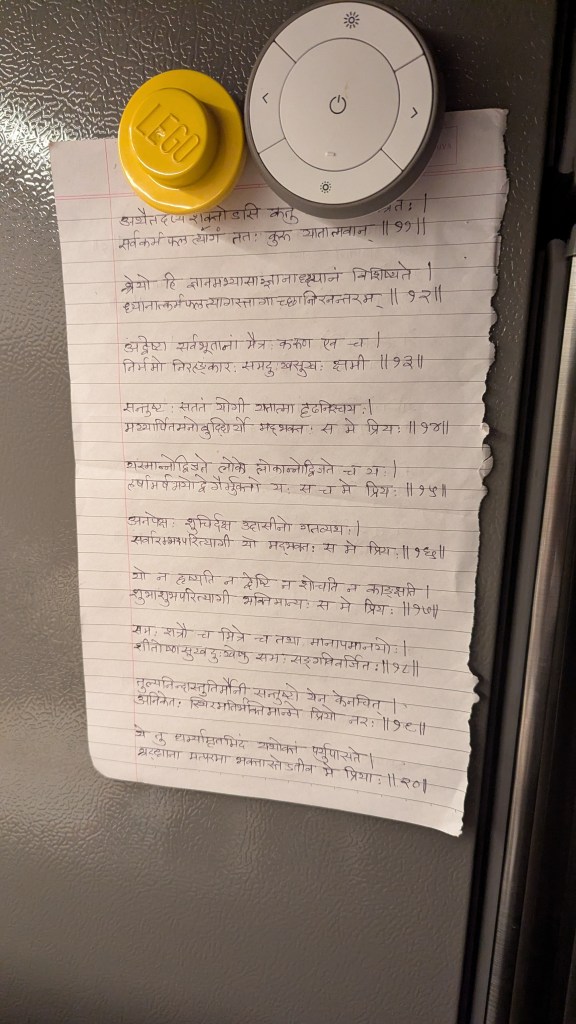
Maybe the real waste isn’t memorizing without understanding.
Maybe it’s understanding too late why memorizing mattered in the first place.
 Words panorama