


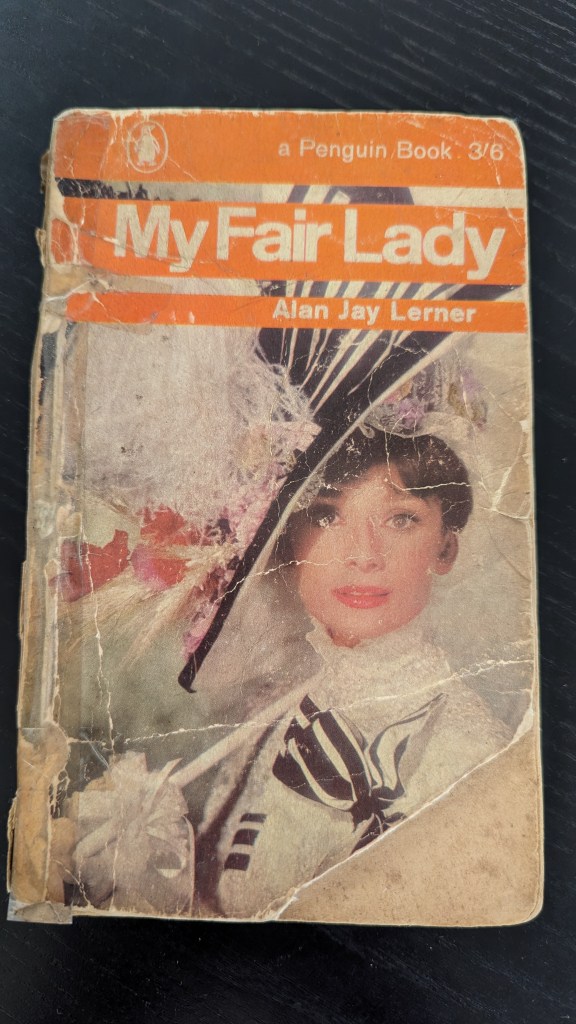
There are many items or I must say possessions attached to us as youth. I think these are precious memories of growth. In those years, I read a book, ‘My fair Lady’ – A Musical by Alan Jay Lerner. Being a Maharashtrian, I read Marathi books, our region’s language. This is a very famous, iconic oscar winning artwork as we all know. This is based on the play “Pygmalion” by George Bernard Shaw.

We have a Marathi adaptation of this play as ‘Ti Fulrani’, written by P. L Deshpande, a well-known and accomplished writer. I read this book and saw the play in Marathi. I was mesmerized by the write-up and approach towards language.
Then I saw the movie, My Fair Lady, which is a masterpiece. Each and every actor’s work is excellent. That movie showed me the worth of language, its importance and variations in speech, and how language depicts every character. This book will always remain a priced possession for me. “Here is a review for those who have not read the book.”
This play was first performed in 1913. The name Pygmalion comes from a Greek sculptor in mythology who, according to legend, fell in love with one of his sculptures, and it came to life. Inspired by this story, the play was likely given its title.
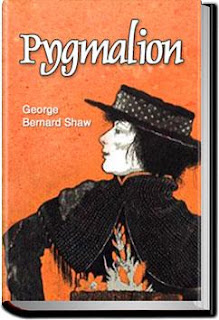
The play is set in Europe during the early 20th century. It revolves around two main characters: a professor of phonetics and a flower-selling girl. The professor, Henry Higgins, is an unmarried man in his fifties, and the young flower girl is Eliza Doolittle. They meet by chance on the street while she is selling flowers, some people are waiting for a taxi, and others are asking if the rain has stopped. Meanwhile, the professor is busy noting down everything he hears in a notebook. When people express curiosity, he impresses them by identifying everyone’s birthplace or residence solely based on their speech. He remarks how poorly English is spoken nowadays and confidently claims that if given six months to train this girl, he could transform her into a duchess.
Nearby, a gentleman named Colonel Pickering, who is also a linguist, introduces himself to the professor, intrigued by his bold claim. Their shared academic interests lead the professor to invite Pickering to his home. Eliza, overhearing Higgins’s remark, feels inspired to improve her speech so she can speak gracefully like the girls working in flower shops. Motivated by this thought, she voluntarily approaches the professor to learn how to speak properly. Eventually, she agrees to participate in Higgins’s wager and begins learning refined speech and manners suitable for royalty.
At one point, Eliza’s father visits Higgins and casually accepts money in exchange for letting his daughter stay with him. The professor, while teaching Eliza proper behavior, is himself rather unruly, though he is highly knowledgeable in language. In contrast, Pickering treats everyone with respect and kindness. Once Eliza is well-prepared, Higgins and Pickering present her at various social gatherings as a lady of high society. These situations lead to both amusing mishaps and triumphant moments. During one such event, a young man named Freddy falls in love with Eliza.
As the experiment nears its end and Eliza transforms into a refined lady, Higgins and Pickering indulge in self-praise, marveling at how they accomplished such an impossible task. They even discuss how repetitive and tiresome it became to teach her the same lessons over and over. However, they fail to acknowledge or appreciate Eliza’s innate grace, her willingness to learn, her memory, and her adaptability. Feeling unappreciated, Eliza decides to leave. Even when Higgins comes to persuade her to return, she refuses. Higgins, however, believes not only that she should come back but feels confident that she will. Eliza, on the other hand, quietly cherishes a bond of unspoken friendship and love but ultimately declares her decision to marry Freddy.
This storyline certainly gives the impression of a love story. It is said that due to public demand, the ending of the play was later changed. However, the playwright provided a very realistic response, arguing that the original ending was appropriate. Shaw emphasized the rigid British class system of that era, the social divide, and the limited opportunities and freedoms available to women, making a strong case for the play’s original conclusion.
 Words panorama